

Rethinking Risk Management for Autonomous Systems
Aigentsphere at the Gartner Data & Analytics Summit, Sydney
Jun 16, 2026
AI agents are not better chatbots. They are delegation mechanisms — systems that plan, call tools, trigger workflows, coordinate with other agents, and act across many steps without waiting for human approval. And that changes everything about how organisations need to think about risk.
At the Gartner Data & Analytics Summit in Sydney, Aigentsphere Co-Founder & CEO Quinton Anderson made the case that scaling agentic AI introduces risk vectors that conventional frameworks were never designed to handle — and that the way forward is not to wait for a new rulebook, but to apply rigorous, layered risk management discipline to systems that act at machine speed.
Why Agentic Risk Is Different
Three properties of autonomous agents break the assumptions most governance frameworks are built on:
- Cascading automated decisions compound faster than any human can review
- Opaque multi-agent chains mean failures can propagate where no one has end-to-end visibility
- Probabilistic actors inside deterministic infrastructure create a fundamental mismatch between how agents reason and what the systems around them expect
What Organisations Should Do
Rather than treating agentic AI as an entirely new discipline, Quinton argued that the management fundamentals remain sound — they just need to be applied deliberately to a new kind of actor.
Layer accountability: Every governance, risk and control layer must trace to a named human owner. Risk cannot be delegated to code — whoever runs the agent owns its risk.
Build on existing frameworks: NIST AI RMF, ISO 42001, the EU AI Act, and local standards like APRA CPS 220/230 already apply to the outcomes agents produce. Organisations don't need to wait for agent-specific regulation to act.
Accept that agents cannot be made deterministic: The goal is not a one-time certification of safety — it is continuous convergence. Bound the blast radius, sense drift, and correct quickly.
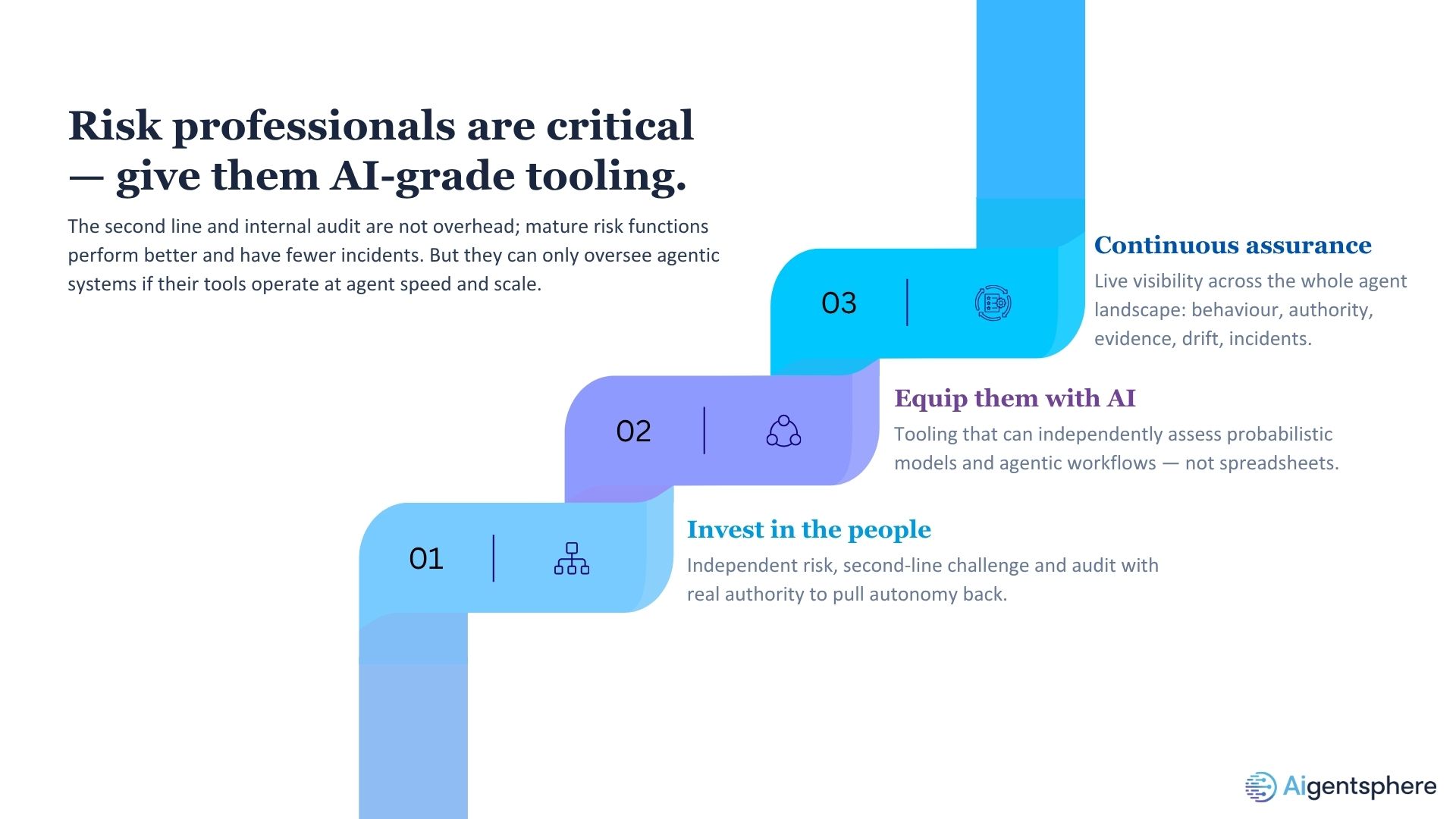
Invest in risk professionals — and give them AI-grade tooling. Second-line risk and internal audit functions are essential, but they can only oversee agentic systems if their tools operate at agent speed. Regulators, including APRA, are now making this expectation explicit.
Operationalise incrementally. Define the operating envelope before deployment. Constrain authority by reversibility and reach. Instrument the runtime. Monitor outcomes continuously. Maintain a rapid-correction playbook with real authority to reduce scope, gate, or roll back.
"The vocabulary is new. The discipline is not. Anchor it to who is accountable."